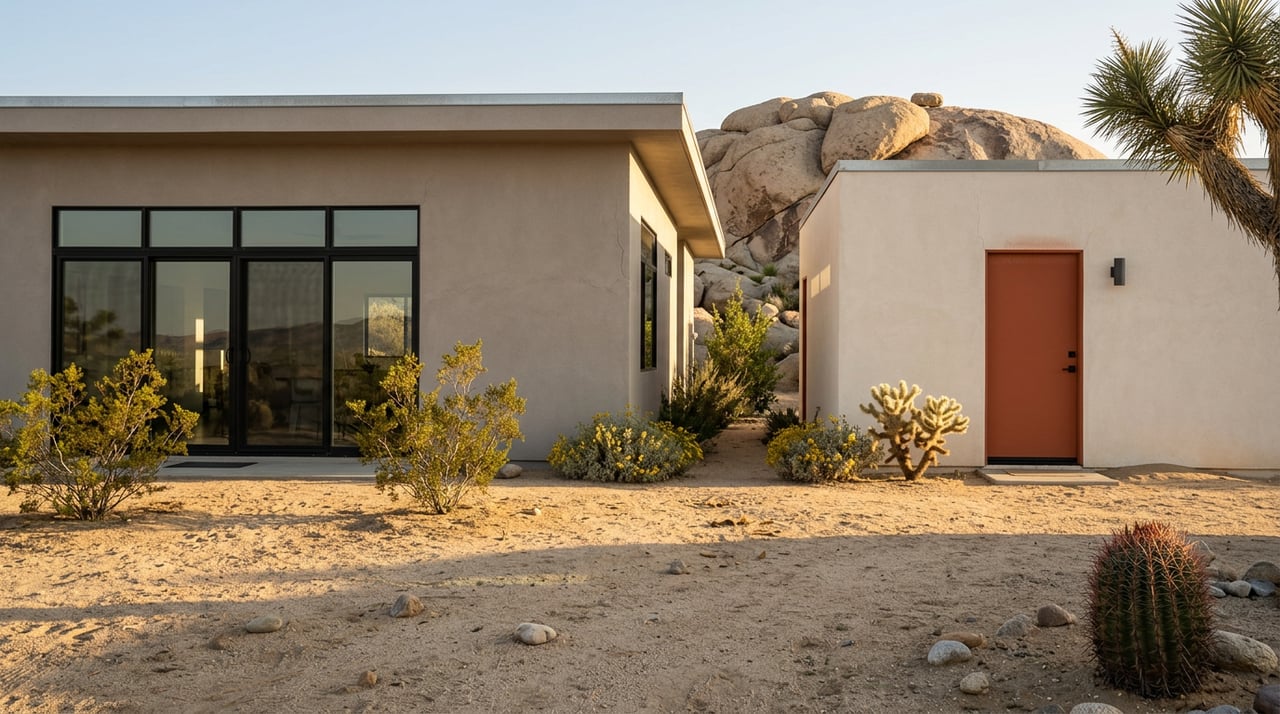
Joshua Tree STR Permit Investment Rules for Buyers
August 27, 2026
August 27, 2026
An investor closes escrow on a Joshua Tree property with an active Airbnb listing and a solid twelve months of booking history. The assumption, reasonable enough, is that the rental business transfers with the keys. It doesn't. The permit that makes the income legal is tied to the person who holds it, not the parcel, and reissuing it into a new owner's name is a separate transaction with its own rules, its own fee, and its own way of failing.
That gap between what a listing implies and what a county permit actually allows is the part of Joshua Tree's short-term rental market that rarely makes it into a market report. The headline numbers everyone quotes, median price, days on market, get plenty of attention. The permit mechanics that determine whether those numbers translate into legal rental income get almost none.
Joshua Tree sits in unincorporated San Bernardino County, and every short-term rental there operates under Chapter 84.28 of the county code, which governs the Mountain and Desert Regions. The county's fee schedule, effective July 1, 2025, sets a new-application cost of $1,144, broken into a $600 application fee, a $285 permit fee, and a $259 neighbor notification fee. Renewing an existing permit with no changes costs $550. Owners who install an approved outdoor noise-monitoring device get a one-time $150 credit, which matters more than it sounds like it should, since noise complaints are what generate most enforcement action in the first place.
When a property with an active permit changes hands, the county treats that as an ownership change to the existing permit rather than a fresh application. According to the fee structure specific to Joshua Tree, that reissuance runs $275. It's a smaller number than the full new-application fee, which is the good news. The catch is that a $275 reissuance still has to clear the county's ownership caps, and that's where a buyer's own rental portfolio can quietly disqualify them before the deal ever closes.
San Bernardino County caps short-term rental permits at two per person, corporation, trust, LLC, or LLP. Owners who already held more than two before the cap took effect were grandfathered in, but nobody adds a third. That cap applies to the buyer, not just the seller.
If an investor already holds two STR permits anywhere in the county and buys a third home that comes with an existing, valid permit, that permit does not automatically follow them into the deal. The seller's permit was theirs. The buyer's own count is what the county checks when the reissuance request lands on a desk. A property that's been generating solid income under one owner can go dark under the next simply because the new owner already maxed out their own allotment somewhere else in the Mountain and Desert Regions.
This is the kind of detail a pro forma built off a listing's trailing twelve months of Airbnb revenue will never surface. It only shows up when someone actually checks the buyer's existing permit count against the county's cap before the offer goes in, not after.
The other hard gate in Chapter 84.28 has nothing to do with the house and everything to do with the parcel. A lot under two acres is limited to one STR permit, full stop. A lot of two acres or more can hold two. Occupancy on any permitted unit tops out at twelve overnight guests regardless.
| Parcel size | Max STR permits allowed | What that means for a buyer |
|---|---|---|
| Under 2 acres | 1 | Main house or guest house, not both, as separate short-term rentals |
| 2 acres or more | 2 | Main house and a separate structure, like a casita, can each be permitted |
This means a beautifully renovated architectural home on a 1.4-acre lot can never support a second permitted rental structure no matter how the property is designed or subdivided internally. A more modest home on 2.1 acres can. For anyone evaluating a main-house-plus-casita strategy, the acreage on the assessor's parcel map decides the play well before the floor plan does. It's worth pulling that number before falling in love with a listing's architecture.
California's Short-Term Rental Facilitator Act, Senate Bill 346, took effect January 1, 2026. It gives cities and counties the authority to compel platforms like Airbnb and Vrbo to hand over host and property data, including physical addresses, and to fine platforms up to $10,000 a day for noncompliance once a local ordinance invokes that authority.
The law is not self-executing. A jurisdiction has to adopt its own ordinance referencing the state framework before any of that enforcement power applies locally. As of a July 2026 review of the county's ordinance activity, San Bernardino County had not adopted an implementing ordinance under SB 346. In practical terms, that means the new law hasn't yet added enforcement teeth in Joshua Tree specifically, though Chapter 84.28 already requires a permit number on every listing and already lets the county subpoena platform data when it needs to, so the gap in day-to-day enforcement is smaller than the new statute alone might suggest.
Anyone comparing Joshua Tree listings across sites has probably noticed the numbers don't agree, and they genuinely don't. Over the three months ending June 2026, the median sale price came in at $475,000, up 19.7 percent year over year, with days on market falling to 47 from 81 the year before. For July 2026 alone, the median sale price read $425,000, with days on market climbing to 149 from 130 the prior year. A separate home-value estimate for July 31, 2026 put the average home value at $351,052, up just 0.6 percent over the past year.
Three sources, three different price levels, and two of them disagree on whether homes are selling faster or slower than a year ago. That's not a data error. It's what happens in a market where monthly sales volume runs somewhere between 34 and 199 transactions across a large and architecturally varied high desert area. A handful of high-end closings in a given month can pull a median price up without reflecting any real shift in what a typical buyer is paying, and a single portal's snapshot window can catch a different slice of that mix than another's.
The steadier number in the mix is price per square foot, which came in at $278 for the three months ending June 2026, up 2.8 percent year over year. That's a smaller move, and a more believable one, than a 19.7 percent swing in median price built on 34 sales.
The practical lesson isn't to pick a favorite portal. It's to treat any single headline number, especially one built on a low monthly sales count, as a starting point rather than a verdict, and to look at price per square foot and the specific parcel-size and permit-status bracket a property actually sits in before anchoring an offer to a market narrative that may not hold up outside that one month's sample.
Does the two-permit cap apply the same way to an LLC as it does to an individual? Yes. The county's cap applies per person, corporation, personal or family trust, LLC, or LLP, so structuring the purchase through an entity doesn't create a separate allotment.
If a home already has two active permits under the current owner, can a buyer add a third permit for a new structure later? No. The two-permit-per-parcel-tier system is set by acreage, not by owner intent, so a parcel under two acres stays capped at one permit and a parcel of two acres or more stays capped at two, regardless of who owns it.
Is Joshua Tree more or less restrictive than other desert markets nearby? Every jurisdiction in the region writes its own rules, and Joshua Tree's permit structure, sitting under county rather than city authority, differs meaningfully from incorporated cities nearby. Confirming which government body actually governs a specific address is a necessary first step, since a Joshua Tree mailing address doesn't always mean county rules apply.
Rental income projections built on a listing's history are only as good as the permit that makes them legal. If you're evaluating a Joshua Tree property with short-term rental income in mind, the team at John & Ryan can walk through the permit specifics on a given parcel before you write an offer. Schedule a consultation and let's look at the numbers that actually hold up.
Stay up to date on the latest real estate trends.
Etiam non quam lacus suspendisse faucibus interdum. Orci ac auctor augue mauris augue neque. Bibendum at varius vel pharetra. Viverra orci sagittis eu volutpat.