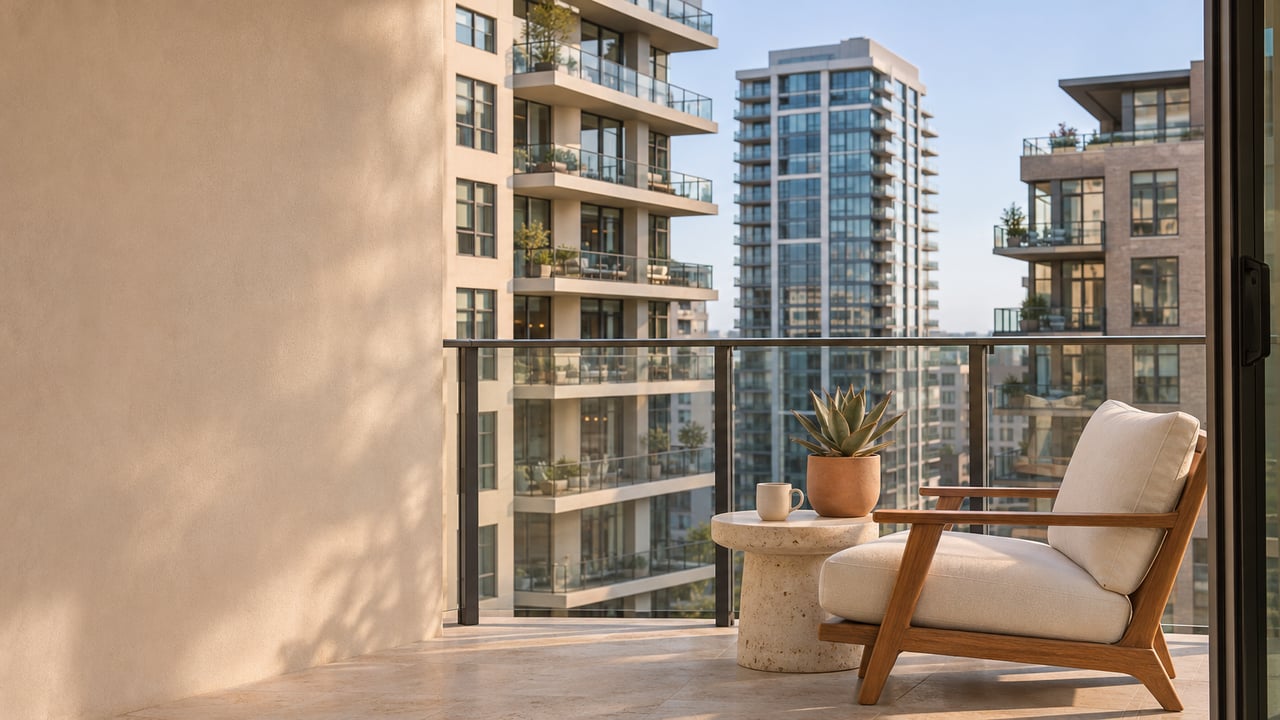
What Downtown San Diego's Apartment Boom Means for Condo Buyers
November 19, 2026
November 19, 2026
At the corner of India and Fir in Little Italy, the lot that held Blick Art Materials for about four decades is turning into Après Little Italy. It is a 25-story tower close to the Little Italy sign, with 154 homes. All 154 are apartments, and The San Diego Union-Tribune reports that the project needs at least another two years to finish. Across Little Italy, the same reporting counts six proposed projects plus Après, up to 1,841 new homes. None of them are condominiums.
The usual reasoning says a neighborhood that adds almost no new condos should have a tight condo market. Downtown San Diego's condo market isn't tight. In October 2026, the 92101 ZIP code had more than seven months of supply in its condo and townhome category. Countywide, that category had four. The reason is that someone deciding whether to buy a downtown condo isn't choosing mainly between two condos. They're choosing between a condo and a new apartment lease, and the apartment side of downtown has plenty of empty units.
The Greater San Diego Association of Realtors publishes a monthly update for each ZIP code. The October 2026 report for 92101, current as of November 5, puts condos and townhomes together under "attached" homes. Downtown has almost no detached houses, so this category covers nearly the whole resale market.
| 92101 attached homes | October 2025 | October 2026 |
|---|---|---|
| Median sales price | $676,450 | $659,950 |
| Closed sales | 51 | 51 |
| Days on market until sale | 47 | 56 |
| Homes for sale | 257 | 319 |
| Months of supply | 5.6 | 7.6 |
| Percent of original list price received | 96.1% | 94.5% |
October sales held level at 51 in both years. What changed is everything around those sales. More condos are sitting on the market, they take longer to sell, and they close further below their first asking price. The year-to-date numbers through October show the same thing. New listings rose 5.9% to 1,247, pending sales fell 4.6% to 452, and the median price dropped 3.0% to $693,700. The association notes that its percentage changes use rounded figures and can look extreme when samples are small. With roughly 50 closings a month, any single month is a rough reading.
Countywide, the same association's October report shows a smaller gap. The attached median was $658,000 for October, down 0.2% from a year earlier. Detached homes rose 6.5% to $1.065 million. Attached homes across the county had 4.0 months of supply in October, compared with 2.6 for detached homes. So condos and townhomes are the softer half of the market everywhere in San Diego County. Downtown's 7.6 months is close to double the county's attached figure, which means something local is happening on top of the countywide trend.
The local factor is the rental market. In its October 28 report on San Diego rents, the Union-Tribune cites CoStar figures for downtown San Diego. Average rent was $3,106 a month, up 0.5% over the year, and vacancy was 10.7%. The county built 6,927 apartments in 2025, the most in 25 years of data. CoStar expected another 6,400 to open by the end of 2026, with 7,600 more under construction.
When that many units need tenants, landlords compete on price without lowering the posted rent. Joshua Ohl of CoStar told the paper that some landlords are offering up to 10 weeks of free rent. He put the county's effective rent, after those incentives, at about $2,496 a month, compared with an advertised average of $2,587. His largest example, AMLI Aero, is in Serra Mesa rather than downtown. He also described a "domino effect" of incentives reaching mid-tier buildings across the market.
For a condo owner selling in 92101, this explains the October numbers. Many buyers could also lease a downtown apartment in a market where landlords are competing for tenants, and every condo listing is measured against that option. Every empty apartment a buyer could lease instead counts as supply that shapes condo prices, and with 10.7% vacancy, downtown has a lot of them.
The 92101 numbers combine several very different neighborhoods. The rental data shows how wide the gap is. The Union-Tribune's November 13 report puts Little Italy's average rent at $3,625 a month, about $1,000 above the county average, with vacancy around 5.7%. That vacancy rate matches the county. East Village's vacancy rate is 10%.
A condo buyer can use this. In East Village, where one apartment in ten is empty, a renter has the most choice of any downtown neighborhood in the report, and a condo seller has the most competition from leases. In Little Italy, apartments fill at higher rents, so the rental alternative costs more and gives less room to negotiate. That's the reason developers want to build there. Ben Tashakorian of Legacy West Partners, who has owned a Cedar Street site next to the trolley tracks since 2014, plans to take a 138-unit, 11-story apartment proposal to the city's planning commission in December.
Little Italy's apartment pipeline is large, though. It includes 492 units proposed at 444 West Beech St. in a 40-story building, and 444 units at 1950 India St. on the site of the Alsco commercial laundry, which operated for about a century. Kettner Crossing II has 377 units and 610 W. Ash St. has 184. The paper notes that not every project will be built and that construction may take years. If most of them are built, Little Italy's low vacancy rate will face its own wave of new apartments. A buyer comparing a Little Italy condo with one in East Village is also judging how long Little Italy's advantage over East Village will last.
The main exception downtown is Andia. Bosa Development's 40-story, 399-unit tower sits on B Street between Eighth and Ninth avenues, at the edge of East Village. When sales opened, the Union-Tribune called it downtown's first condo tower in eight years. It began construction as an apartment project in 2022. Two years later, Bosa switched it to condos, saying condos would earn a better return. The city's July 2026 downtown development log lists Andia among 1,269 residential units under construction downtown. Its architect, JWDA, gave a 2027 completion date in April 2026.
Andia's launch figures from June 2025 show the cost of owning in a new building. One-bedrooms started in the high $500,000s, two-bedrooms in the low $800,000s, and three-bedrooms at around $1.7 million. Monthly HOA dues were $1,114 to $1,364. Those dues equal roughly 36% to 44% of downtown's October 2026 average rent of $3,106, before any mortgage payment. A buyer comparing a full-amenity condo with a lease is setting the HOA bill alone against more than a third of a month's rent. The June 2025 figures may have changed since launch, so check current dues on any specific unit. This post is general market information, not legal, tax or financial advice. Confirm the costs that apply to your situation with your lender and other qualified professionals.
The two Union-Tribune reports point to two ways the current gap between rental and condo supply could shift. Housing analyst Gary London told the paper in October, "Clearly, we overbuilt rental inventory in key urban areas: downtown, (University City), Mission Valley and a few other places." He said he sees potential for some high-end rental projects to consider converting to condos. In November, the paper reported that Marco Li Mandri, former head of the Little Italy Association, was disappointed that none of the neighborhood's proposals were condominiums. The paper connects the lack of condo construction to California's condo defect law and notes that some lawmakers and business leaders hope a legislative change is coming.
Either change would add condos to the market. A buyer today is choosing at a time when for-sale supply is small but growing slowly, and the rental alternative is large and discounted. That combination produced 94.5% of original list price in October.
Does a soft resale market mean downtown condos are losing value? The October 2026 median for 92101 condos and townhomes was 2.4% below October 2025, and the year-to-date median was 3.0% lower. The figures show modest price movement, along with more time on market and more negotiating room for buyers.
Why compare a condo to an apartment rather than to another condo? Downtown's apartment vacancy was 10.7% in CoStar's October figures, so most buyers can also choose to lease. That option sets a ceiling on what many of them will pay.
Is the picture the same outside downtown? Countywide, attached homes had 4.0 months of supply in October, compared with 7.6 in 92101. Condos are softer than houses across the county, and the gap is widest downtown. Our San Diego neighborhood page and our post on moving from the desert to coastal San Diego cover coastal options outside downtown.
If you're weighing a specific downtown building, John & Ryan Real Estate Group can put that unit's asking price, dues and time on market next to what the same monthly cost would rent nearby, so you can make an offer with both options in front of you. Schedule a consultation and we'll go through the numbers for the buildings on your list.
Stay up to date on the latest real estate trends.

Etiam non quam lacus suspendisse faucibus interdum. Orci ac auctor augue mauris augue neque. Bibendum at varius vel pharetra. Viverra orci sagittis eu volutpat.